Wednesday, June 24, 2009
Project Update: The Law School Redesign
Last week, the University of Chicago Law School (where I am the Manager of Electronic Communications) launched its redesigned website. I have been working on this project in one form or another since I was hired in late 2007, and, like most projects of such size, the launch is by no means the end of the work needed. As a result, it has been hard to wrap my head around the fact that this stage of the project is complete. However, I thought this was a good time to ste back and reflect a little on the process.
In many ways, this project has been very unlike the other projects I've detailed on this block. This is by the far the biggest project that I have worked on, both in terms of amount of content and the number of people involved. While most of my previous projects have involved, at most, the client plus one other designer, this one involved a team of two designers (from the small Chicago design firm Rogue Element) and a development team of half a dozen members of the Chicago web development firm Palantir.net, not to mention the many stakeholders at the Law School itself.
Also unlike other projects I've worked on, in which I've often done design and development, my role here was generally limited to information architecture and project management. Aside from gaining some valuable experience in keeping so many moving parts going in the right direction, this also meant that I had the chance to observe the processes by which Rogue Element and Palantir worked. Getting to observe some more-experienced colleagues as they worked was a great learning experience.
The biggest difference between this project and the others I've worked on, however, was that I was, for the first time, playing the role of the client while working with other designers and web professionals. This is something that I think most web designers don't get the chance to do often, and I found that it provided me with some valuable insight into the assumptions at play on both sides of the working relationship. I hope that I can use this insight to make my own interactions with clients even more productive.
In many ways, this project has been very unlike the other projects I've detailed on this block. This is by the far the biggest project that I have worked on, both in terms of amount of content and the number of people involved. While most of my previous projects have involved, at most, the client plus one other designer, this one involved a team of two designers (from the small Chicago design firm Rogue Element) and a development team of half a dozen members of the Chicago web development firm Palantir.net, not to mention the many stakeholders at the Law School itself.
Also unlike other projects I've worked on, in which I've often done design and development, my role here was generally limited to information architecture and project management. Aside from gaining some valuable experience in keeping so many moving parts going in the right direction, this also meant that I had the chance to observe the processes by which Rogue Element and Palantir worked. Getting to observe some more-experienced colleagues as they worked was a great learning experience.
The biggest difference between this project and the others I've worked on, however, was that I was, for the first time, playing the role of the client while working with other designers and web professionals. This is something that I think most web designers don't get the chance to do often, and I found that it provided me with some valuable insight into the assumptions at play on both sides of the working relationship. I hope that I can use this insight to make my own interactions with clients even more productive.
Labels: projectupdate, webtech
Monday, May 25, 2009
Project Update: On the Table
My stepfather, Gary Allen, is a professional food writer/editor/eater (ok, he doesn't technically get paid to eat, but he takes it at least as seriously as any paying gig). Last year, as a birthday gift, I offered to redesign his website. His original site (which he had built himself using Dreamweaver) had served him well enough over the years, but I felt that I could improve upon it and help him generate more leads, more jobs -- and, of course, a bigger inheritance for myself.
I had three goals for the redesign of the site:
1) Give the site a more professional look without losing the personality and sense of humor of the original. While Gary had been a professional illustrator and print designer earlier in his career, he didn't quite know how to make those skills translate onto the web. I felt that, if the web site was going to be his professional face, it needed a cosmetic overhaul. But I wanted to be sure that the look retained the quirkiness (and faint whiff of curmudgeon) that seemed to be part of what set him apart from his peers. As it turned out, this was actually the easiest part of the project. One of the advantages of having a close family member as a client is that you don't necessarily need to spend a lot of time getting to know them, their likes and dislikes, and so on. I initially pitched a "tongue-in-cheek antiquarian" approach, and Gary, while suggesting afew tweaks (the curve on his name, which really helped smooth out the header, was his idea), loved my first draft.
2) Refine the site's information architecture to highlight Gary's wide variety of skills. The original site contained a lot of information. Because it had grown up rather organically, it was not always clear how certain pages were related to others, and there was no consistent navigation. Since the the site's primary purpose was to land Gary more jobs, I decided to focus the information architecture around the different skills he can brings to, ahem, the table. This way, the visitor is quickly made aware of what Gary can do for them and their food-related projects.
3) Make it as easy as possible for visitors to sign up for his newsletter. For years, Gary has sent out a weekly email featuring culinary quotes, links to food-related sites and other such miscellanea. With nearly 600 subscribers, this newsletter has been Gary's primary promotional tool for many years; however, it was nearly impossible to find out how to sign up for it on his old site. So I wanted to make sure that there was a sign-up for the mailing list on every page. I also wanted to ensure that visitors could use subscribe an RSS feed of his updates, so I convinced him to turn the mailing list into a blog ("Just Served") that is integrated seamlessly into the site. This gives him the advantage of consistently adding new content to the site (a plus for search engine optimization) as well as the ability to archive his weekly updates on the site.
Below are images of the original site (left) and post-redesign (right).

I had three goals for the redesign of the site:
1) Give the site a more professional look without losing the personality and sense of humor of the original. While Gary had been a professional illustrator and print designer earlier in his career, he didn't quite know how to make those skills translate onto the web. I felt that, if the web site was going to be his professional face, it needed a cosmetic overhaul. But I wanted to be sure that the look retained the quirkiness (and faint whiff of curmudgeon) that seemed to be part of what set him apart from his peers. As it turned out, this was actually the easiest part of the project. One of the advantages of having a close family member as a client is that you don't necessarily need to spend a lot of time getting to know them, their likes and dislikes, and so on. I initially pitched a "tongue-in-cheek antiquarian" approach, and Gary, while suggesting afew tweaks (the curve on his name, which really helped smooth out the header, was his idea), loved my first draft.
2) Refine the site's information architecture to highlight Gary's wide variety of skills. The original site contained a lot of information. Because it had grown up rather organically, it was not always clear how certain pages were related to others, and there was no consistent navigation. Since the the site's primary purpose was to land Gary more jobs, I decided to focus the information architecture around the different skills he can brings to, ahem, the table. This way, the visitor is quickly made aware of what Gary can do for them and their food-related projects.
3) Make it as easy as possible for visitors to sign up for his newsletter. For years, Gary has sent out a weekly email featuring culinary quotes, links to food-related sites and other such miscellanea. With nearly 600 subscribers, this newsletter has been Gary's primary promotional tool for many years; however, it was nearly impossible to find out how to sign up for it on his old site. So I wanted to make sure that there was a sign-up for the mailing list on every page. I also wanted to ensure that visitors could use subscribe an RSS feed of his updates, so I convinced him to turn the mailing list into a blog ("Just Served") that is integrated seamlessly into the site. This gives him the advantage of consistently adding new content to the site (a plus for search engine optimization) as well as the ability to archive his weekly updates on the site.
Below are images of the original site (left) and post-redesign (right).

Labels: design, projectupdate, webtech
Wednesday, April 22, 2009
For the Record (Store)
Last week was the second annual Record Store Day, the admirable goal of which is to get people to support their local record store. This past weekend, Sound Opinions devoted their show to interviews with some of the heavy hitters of independent music stores, including Chicago's Reckless Records, the Bay Areas's Amoeba Music, and Austin's Waterloo Records. They also spent a great deal of time rhapsodizing over the nostalgic wonders of the record store that can not possibly be replicated by digital downloading.
I have to admit, it's been a while since I bought anything in a record store (I get most of my music these days from eMusic). But I find it slightly bizarre that Greg Kot and Jim DeRogatis spend much of their time applauding the changes in the music business that are leading to the collapse of the major labels' outmoded business model, then spend an entire show lamenting the challenges wrought by those changes on the record stores' outmoded business model.
The problem for record stores, I should note, is not that the internet has enabled people to illegally download music that they otherwise have bought in hard copy -- studies indicate that those who download music illegally actually buy more music -- but simply that no brick and mortar store can possibly offer the range of choices one finds on the web. If I want an album by a relatively obscure band like the Pine Hill Haints, I could get on the CTA, go to Reckless Records and try to find it... or I could get on the web and order a copy in the time it would take me to find my keys.
These days, services like iTunes make it almost effortless for independent bands to get their music online, while sites like CDBaby make it possible to get hard copies in the hands of individual consumers without the hassle of finding a distributor to get their music into record stores. The record store as middleman no longer has much reason to exist, unless it can find some way of adding value to the experience of shopping there (and I don't consider being smirked at by a 25-year-old who thinks he's the second coming of Lou Reed but still lives with his parents to be value added). Unfortunately, the future of the record store may very well be that rack by the cash register at Starbucks.
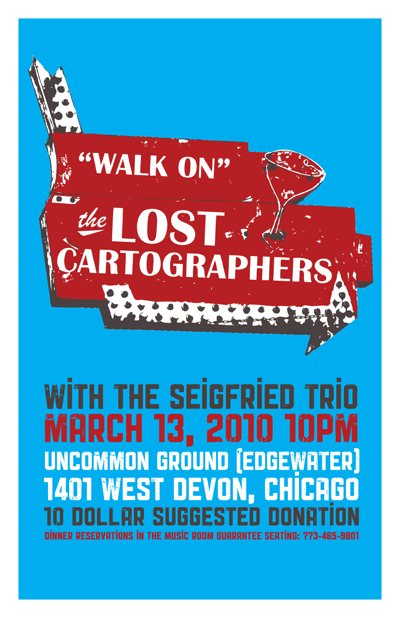
Now, don't get me wrong -- I have fond memories of teenage years spent browsing record stores and blowing my meager summer paychecks (I'm looking at you, Rhino Records in New Paltz), and I still enjoy having a physical copy of a cd, with album art and liner notes and so on. I would love for the Lost Cartographers' music to be able to help support independent record stores, but our label doesn't have a distribution deal, and our fans will only be able to get our music online. And until someone starts a CDBaby-like business aimed at distributing physical product into physical stores (rather than just to individual consumers), record stores simply won't be able to compete with the abundance of music available online.
I have to admit, it's been a while since I bought anything in a record store (I get most of my music these days from eMusic). But I find it slightly bizarre that Greg Kot and Jim DeRogatis spend much of their time applauding the changes in the music business that are leading to the collapse of the major labels' outmoded business model, then spend an entire show lamenting the challenges wrought by those changes on the record stores' outmoded business model.
The problem for record stores, I should note, is not that the internet has enabled people to illegally download music that they otherwise have bought in hard copy -- studies indicate that those who download music illegally actually buy more music -- but simply that no brick and mortar store can possibly offer the range of choices one finds on the web. If I want an album by a relatively obscure band like the Pine Hill Haints, I could get on the CTA, go to Reckless Records and try to find it... or I could get on the web and order a copy in the time it would take me to find my keys.
These days, services like iTunes make it almost effortless for independent bands to get their music online, while sites like CDBaby make it possible to get hard copies in the hands of individual consumers without the hassle of finding a distributor to get their music into record stores. The record store as middleman no longer has much reason to exist, unless it can find some way of adding value to the experience of shopping there (and I don't consider being smirked at by a 25-year-old who thinks he's the second coming of Lou Reed but still lives with his parents to be value added). Unfortunately, the future of the record store may very well be that rack by the cash register at Starbucks.
Now, don't get me wrong -- I have fond memories of teenage years spent browsing record stores and blowing my meager summer paychecks (I'm looking at you, Rhino Records in New Paltz), and I still enjoy having a physical copy of a cd, with album art and liner notes and so on. I would love for the Lost Cartographers' music to be able to help support independent record stores, but our label doesn't have a distribution deal, and our fans will only be able to get our music online. And until someone starts a CDBaby-like business aimed at distributing physical product into physical stores (rather than just to individual consumers), record stores simply won't be able to compete with the abundance of music available online.
Labels: music
Tuesday, March 24, 2009
Moving Pictures
While I've always had a healthy (or maybe less unhealthy than some?) appreciation for comics and animation, I've never been an obsessive fan. Lately, however, it seems that these related media have been popping up in my consciousness quite often. First, my friend Charles gave me as a birthday gift the comic adaptations of two of the Indiana Jones movies, films which we were both deeply enamored with as kids (he found them at a flea market in Michigan). My friend Kim just wrote an excellent blog post about what The Watchmen loses in translation from paper to the big screen, and I listened to an engaging and hilarious conversation between cartoonists Marjane Satrapi (whose graphic novel Persepolis
was turned into an excellent film
) and Chris Ware, who designs incredibly elaborate comics that defy the standard conventions of movement across panels. Finally, I learned that Nina Paley, who created an amazing retelling of the Ramayana using Flash animation and old blues songs, will be appearing on campus at the University of Chicago to discuss her work.
There's little I can say about the power of these media that hasn't been said better by others
, but it did make me realize that this a form of both graphic and narrative design to which I should be paying closer critical attention.
There's little I can say about the power of these media that hasn't been said better by others
Labels: design, recommendations
Wednesday, March 18, 2009
Presentation: Social Media for Arts and Humanities Nonprofits
Today I had the pleasure of participating in The Southside Arts & Humanities Network's Meet the Press 2009 event. I presented with Adam Thurman of the Court Theatre, who gave an outstanding presentation on *why* arts and humanities nonprofits need to be using social media. For my section of the presentation, I discussed the *how,* providing some of strategies and tools that they might be able to use to implement a social media strategy. My powerpoint is available, but I also plan on turning this presentation into a series of blog posts over the next several weeks. Stay tuned!
Labels: meetthesocialmedia, webtech